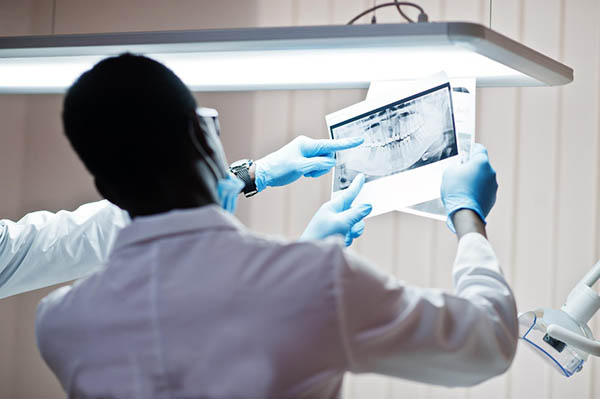
Why X-Rays Are Part of Routine Dental Visits
Dental X-rays are a powerful tool in preventive care. They allow your dentist to see below the surface of your teeth and gums, uncovering early signs of tooth decay, gum disease, bone loss, infection, or even oral cancer. At Ames Dentistry, we use X-rays regularly as part of your checkups to ensure nothing goes undetected. These images help us treat problems early, when they’re easier and less costly to fix.
Addressing Common Fears About Dental X-Rays
If you’ve ever hesitated to get dental X-rays due to radiation exposure, you’re not alone. Many patients have questions like: “Are dental X-rays safe?” or “Do I really need them every year?” The good news is that modern digital X-rays expose you to incredibly low levels of radiation, far less than you receive from everyday activities like flying on a plane or walking outside on a sunny day. At Ames Dentistry, we prioritize your safety while making sure you get the most accurate and effective care.
What Are Dental X-Rays Used For?
Detecting Issues You Can’t See in the Mirror
To the naked eye, your smile might look healthy. But beneath the enamel and gum tissue, problems can be brewing. Dental X-rays allow your dentist to detect:
- Cavities between teeth
- Bone loss from periodontal disease
- Impacted teeth or abscesses
- Infections at the tooth root
- Changes in bone or soft tissues
Preventing Small Problems From Becoming Big Ones
Early detection is everything in dentistry. A small cavity caught early with an X-ray might only require a filling. Left unnoticed, it could turn into a root canal or extraction. Routine imaging allows us to take action before you ever feel pain.
How Often Should You Get Dental X-Rays?
Frequency Based on Age, Risk, and Dental History
There’s no one-size-fits-all schedule. At Ames Dentistry, we tailor the frequency of your X-rays based on:
- Your age and dental development
- Your history of cavities or gum disease
- Your current oral health status
- Any symptoms or risk factors
What to Expect as a New vs. Returning Patient
- New patients often receive a full set of X-rays to establish a baseline.
- Returning patients typically receive bitewing X-rays once a year to monitor changes.
- A panoramic X-ray may be taken every 3 to 5 years to get a complete overview of your mouth and jaw.
Are Dental X-Rays Safe?
Understanding Radiation Exposure Levels
Dental X-rays do involve radiation, but only a tiny amount. For perspective:
- A standard bitewing X-ray delivers about 0.005 mSv of radiation.
- This is roughly equal to a few hours of background radiation from the sun and earth.
- In comparison, a cross-country flight exposes you to about 0.03 mSv.
How Digital X-Rays Minimize Radiation
At Ames Dentistry, we use digital X-rays, which require up to 90% less radiation than traditional film X-rays. They also provide faster, clearer images and are better for the environment, no chemicals, no film.
Comparing Dental X-Ray Radiation to Everyday Sources
Here’s a helpful comparison:
| Source | Approximate Radiation Exposure |
| Bitewing X-ray | 0.005 mSv |
| Panoramic dental X-ray | 0.01 mSv |
| One day of natural background radiation | 0.01 mSv |
| Cross-country flight | 0.03 mSv |
| Mammogram | 0.4 mSv |
Types of Dental X-Rays and What They Show
Bitewing X-Rays
These show the upper and lower back teeth and are commonly used to detect cavities between teeth.
Periapical X-Rays
Used to capture an entire tooth from crown to root, often to check for infections or bone issues.
Panoramic X-Rays
Capture the entire mouth, jaw, and sinuses in one image. Helpful for spotting cysts, impacted teeth, and jaw conditions.
Digital vs. Traditional Film X-Rays
Digital X-rays are faster, emit less radiation, and provide clearer images that can be easily stored and shared.
Benefits of Regular X-Rays for Oral Health
Spotting Problems Early
Routine X-rays help us catch:
- Cavities while they’re still small
- Gum disease before it becomes severe
- Bone loss that’s not yet visible
- Infections or abscesses before pain sets in
Supporting Restorative and Cosmetic Planning
X-rays are critical for planning procedures such as:
- Root canals
- Dental implants
- Crowns and bridges
- Orthodontic treatments
What to Expect During Your X-Ray Appointment
Comfortable, Fast, and Painless
X-rays are quick and easy. Here’s what typically happens:
- You’ll wear a lead apron for protection
- A sensor or film will be placed in your mouth
- The X-ray machine takes the image in seconds
- Your dentist will review the images with you on-screen
Conclusion
Protect Your Smile With Safe, Smart Diagnostics
Dental X-rays are one of the most valuable tools in modern dentistry. They’re fast, safe, and incredibly helpful in keeping your mouth healthy. If it’s been a while since your last set of X-rays, or you’ve been hesitant due to safety concerns, know that at Ames Dentistry, your comfort and well-being come first.
Book your next checkup today by calling our Xenia office at (937) 372-8502 or our Wilmington office at (937) 382-6971. You can also text us at (855) 559-0201. Let’s keep your smile healthy and your mind at ease.